How to Use Grading Standards: CEFR and Cambridge
Last updated: 2026-07-06
A CEFR writing assessment tool is only as useful as the descriptors behind it. Writing, no kidding lets you attach an assignment to a real, named grading standard instead of a generic point scale — so when the AI grades a piece of writing, it's applying that standard's actual band language, not a 1-5 scale relabeled to look official.
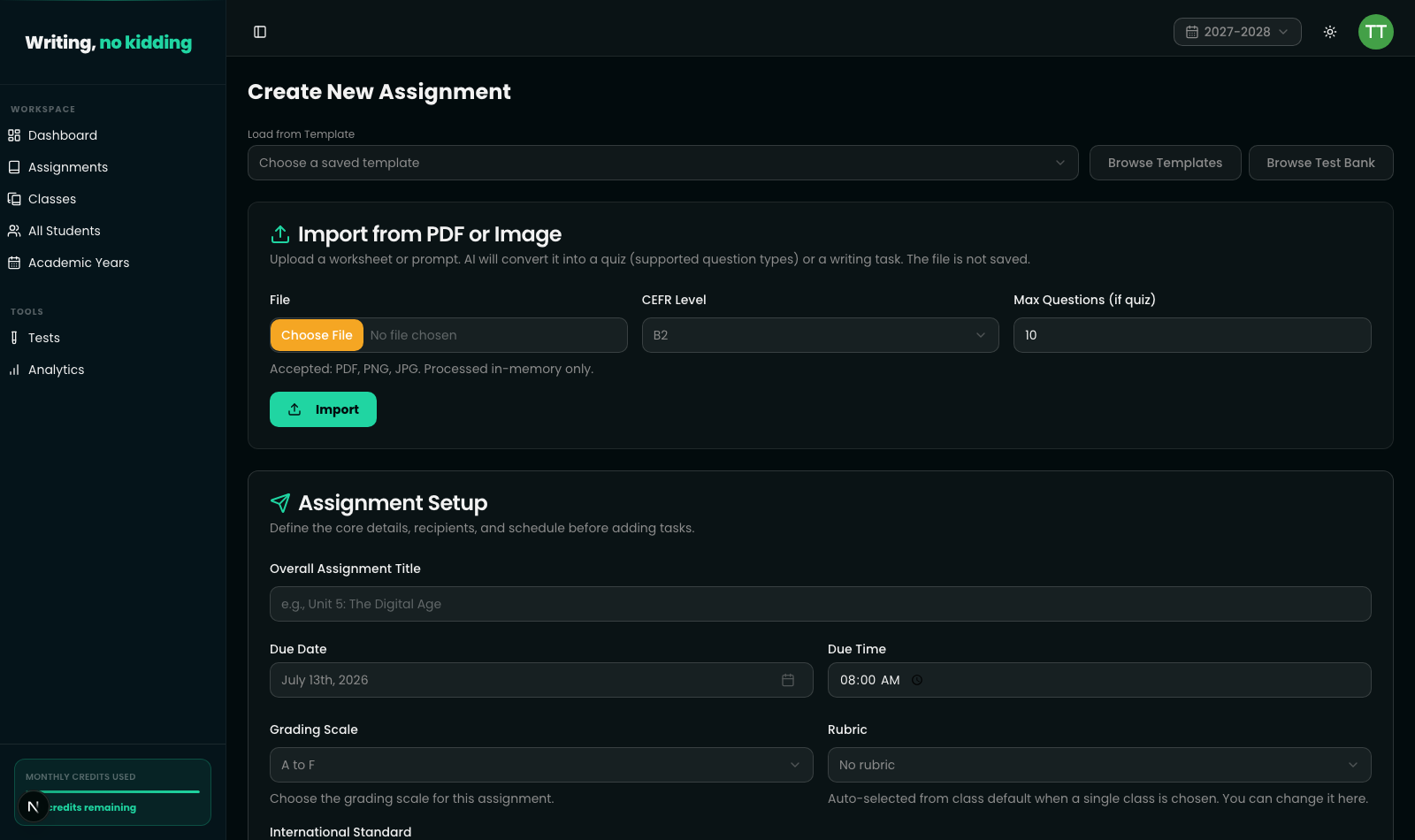
What picking a standard actually changes
On the New Assignment page (Teacher → Assignments → New), alongside the Grading Scale (0-100, 0-10, A-F, or feedback-only) and Rubric pickers, there's an International Standard dropdown, described as grading writing "against an official framework... instead of a custom rubric." Picking a rubric and picking a standard are mutually exclusive — choosing one clears the other, because a standard is really a pre-built rubric with framework-specific grading instructions baked in.
When a standard is selected, AI grading doesn't just reuse your assignment's generic scale — it applies that standard's own criteria and level descriptors, and the AI prompt is given extra guidance specific to that framework. On the submission review screen, a badge shows "Graded against [standard name]" so it's always visible which framework, if any, was used.
What's actually available today
This is important for automated writing evaluation to be accurate rather than aspirational: as of the current build, only two standards are implemented —
- CEFR (A1-C2) — the Common European Framework of Reference levels most ESL/EFL teachers already grade against informally, now formalized with real level descriptors feeding the AI prompt.
- Cambridge B2 First (FCE) Writing — Cambridge Assessment English's exam-specific mark scheme, scored 0-5 per subscale across four dimensions: Content, Communicative Achievement, Organisation, and Language.
IELTS, TOEFL iBT, Trinity (ISE/GESE), and American K-12/Common Core standards are not available yet. They're reserved for future work — the platform's internal roadmap tracks them as planned additions, each requiring its own transcribed, non-hallucinated mark-scheme data before it can be wired into grading. If you don't see one of these in the International Standard picker, that's because it genuinely isn't there yet, not a bug.
Using CEFR grading criteria for teachers who already grade informally
If you already think in terms of "this student is solidly B1" or "this reads like B2," selecting CEFR as the standard turns that intuition into something the AI grades against explicitly and consistently, criterion by criterion, rather than you inferring a level from a generic score after the fact.
Standard vs. custom rubric
A standard is not a replacement for the rubric builder — it's an alternative starting point. If your school or exam context doesn't map cleanly onto CEFR or Cambridge FCE Writing, a custom rubric built in How to Build a Writing Rubric still gives you full control over criteria, weights, and level descriptors. Either way, the AI-assisted score that comes out the other end is one you review and confirm — see How to Grade ESL Essays with AI for that full workflow, and How AI Correction Feedback Works for what the correction pass looks like alongside rubric or standard scoring.
Related reading
Ready to try this in your own classroom?
Related articles
How to Build a Writing Rubric
Build a weighted, CEFR-aligned writing rubric from scratch so AI grading and your own review use the same criteria.
How to Grade ESL Essays with AI
The end-to-end grading workflow: run AI analysis on a submission, review the proposed score, and finalize the grade.
How AI Correction Feedback Works
What the AI Correction Tool actually checks — grammar, vocabulary, structure, and register — and how it presents strengths and next steps.